BCSCP Prep Hub
Making room for practice.
From worksheets to lectures, quizzes, and a learning hub: how the Prep Hub took shape.
Read the notePROJECTS & NOTES BY JOHN DANIEL
Sterile compounding, teaching, and the occasional thing worth building. Here’s what’s taking shape.
Read the latest notesBCSCP Prep Hub
From worksheets to lectures, quizzes, and a learning hub: how the Prep Hub took shape.
Read the noteSterile Compounding Decision Lab
Seven case-based labs and a “Verify the AI” exercise offer a chance to work through evidence, uncertainty, and judgment.
Read the noteHazardous Drug Spill Response
A look at a pilot interface that separates training from live response and lays out the workflow in eight stages.
Read the noteWORK IN PROGRESS
Three projects, each at a different stage. Read a note for context, or open a project to explore it. The wider collection is on my main portfolio (opens in a new tab).
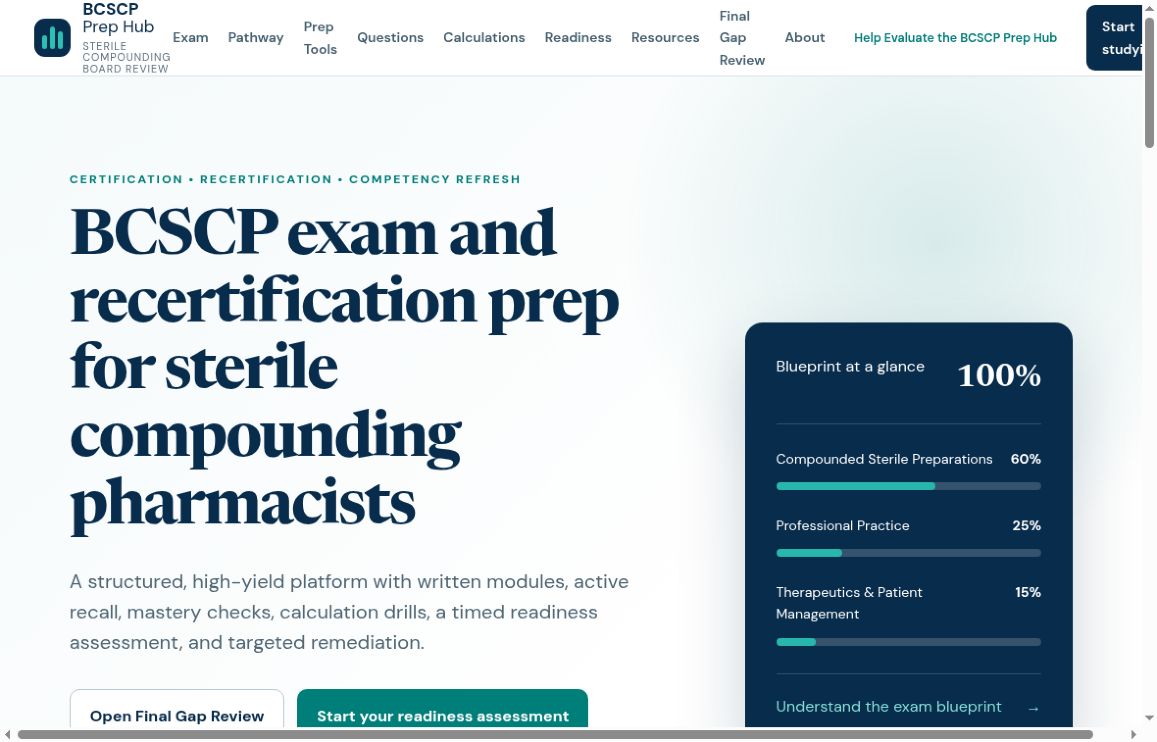
Independent study resource
Written modules, active-recall prompts, calculation drills, and readiness checks for independent study.
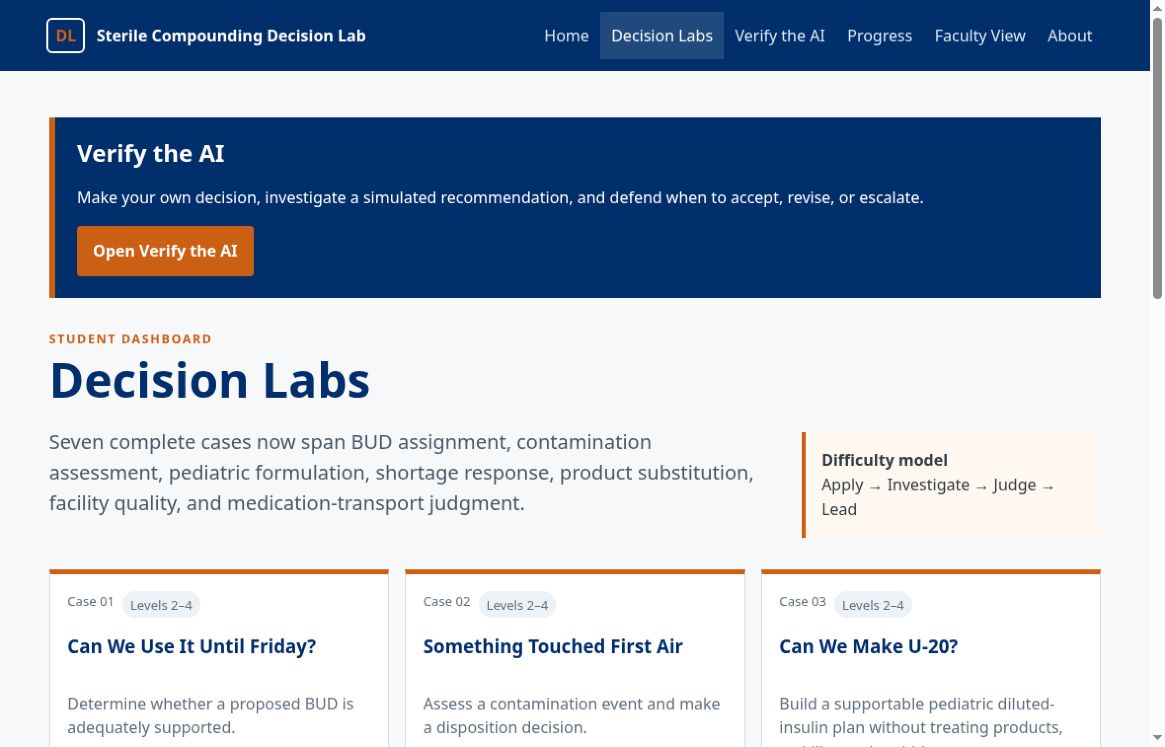
Educational prototype
Seven case-based labs and a “Verify the AI” exercise offer a chance to work through evidence, uncertainty, and judgment.
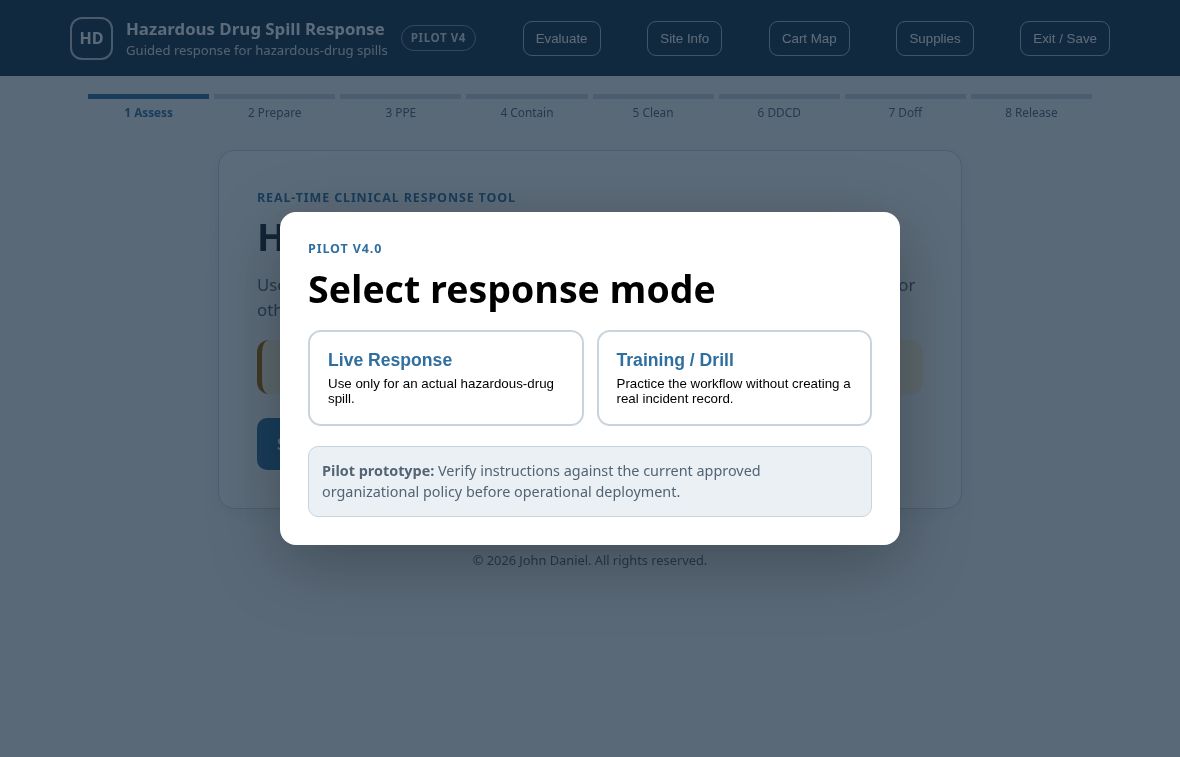
Pilot prototype
A look at a pilot interface that separates training from live response and lays out the workflow in eight stages.
REFERENCE SHELF
The Change Planner and Question Draft Builder prepare downloadable drafts for local review.
Resources & tools →These are independent educational projects and prototypes. Check each project’s scope and disclaimers. None of the notes here establishes clinical readiness or authorizes a practice change.
NOTES FROM MY DESK
Project notes on compounding, learning, and building. Start anywhere.
Search titles, projects, or the full notes.
3 notes
BCSCP Prep Hub
From worksheets to lectures, quizzes, and a learning hub: how the Prep Hub took shape.
Sterile Compounding Decision Lab
Seven case-based labs and a “Verify the AI” exercise offer a chance to work through evidence, uncertainty, and judgment.
Hazardous Drug Spill Response
A look at a pilot interface that separates training from live response and lays out the workflow in eight stages.
Try a different word or browse all notes.
NOTE 01 / Learning design
I was frustrated with the cost of available prep programs and recertifying through continuing education. The Prep Hub grew out of that frustration, one piece at a time.
I started with worksheets. Those grew into lectures, then quizzes, and eventually the learning hub that’s here now.
The hub brings those pieces together with written modules, recall prompts, calculation drills, and an assessment with a domain-level breakdown.
The public hub has a 16-module pathway, 48 calculation drills, and a 60-question readiness assessment. Written explanations sit alongside active-recall prompts and mastery checks. That gives learners a few ways to revisit a topic.
How do those pieces connect? After a missed question, can someone find the explanation, practice the calculation, and decide what to review next? The hub includes targeted remediation and a Final Gap Review to support that path.
What helps you turn a missed question into a useful next study step?
This is an independent educational resource. Its own disclaimer describes the limits of its assessments and readiness estimates. It is not endorsed by BPS or USP, and the readiness tools are not psychometrically validated.
Project features checked against the public site on 15 October 2026. BCSCP Prep Hub
NOTE 02 / Case-based learning
The Sterile Compounding Decision Lab gives learners a case, evidence to inspect, and a decision to work through. The public prototype currently includes seven cases.
The case library spans BUD assignment, contamination assessment, pediatric formulation, shortage response, product substitution, facility quality, and medication transport. The difficulty levels move through Apply, Investigate, Judge, and Lead.
“Verify the AI” adds another exercise: make an initial decision, inspect a simulated recommendation, and explain whether to accept, revise, or escalate it. The advice is fixed and simulated; this activity is a source-verification exercise rather than a live AI agent.
Which part of a case helps you see how someone reached their decision?
The Decision Lab is an educational prototype, not a clinical decision-support system. Case documents and numbers are simulated unless identified otherwise. Its scenarios do not replace authoritative standards, institutional policy, or professional judgment.
Based on the public project as viewed on 15 October 2026. Sterile Compounding Decision Lab
NOTE 03 / Workflow prototype
The Hazardous Drug Spill Response project is a pilot interface with an eight-stage workflow. Its mode selector distinguishes Training / Drill from Live Response and displays a policy-verification warning.
A visible progress strip keeps the stages in view. The public interface also has entry points for site information, a cart map, and supplies. These offer a way to look at how a tool presents a complicated process.
The distinction between a drill and an actual incident matters. The mode selector says that training lets a user practice the workflow without creating a real incident record. That separation is part of the pilot’s interface, and worth keeping explicit.
In a training drill, where does the interface make the next step clear, and where does it need more explanation?
The project labels itself a pilot prototype and says its instructions must be checked against current approved organizational policy before operational deployment. This note is a project overview, not spill-response guidance or a claim of clinical readiness.
Based on the public project as viewed on 15 October 2026. Hazardous Drug Spill Response
A LOOSE PAGE
The link may be out of date. You can find all three notes in the archive, or start again at my desk.